
+255 22 2773038 / +255 22 2773048
Tanzania : Freedom of Expression in Peril (note)
- Home
- Tanzania : Freedom of Expression in Peril (note)
Tanzania : Freedom of Expression in Peril (note)
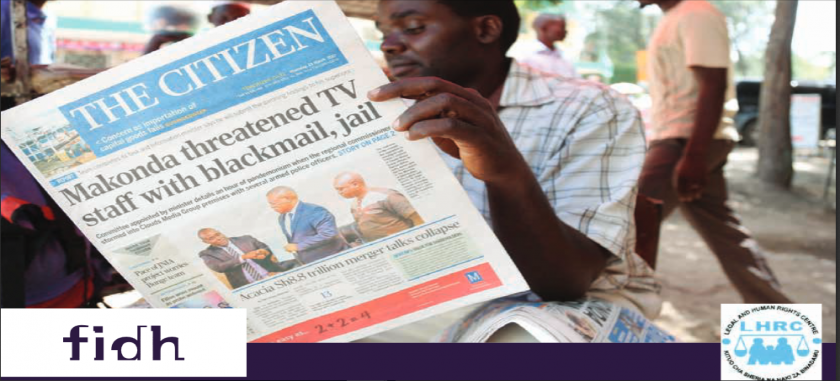
Paris - Dar Es-Salaam, August 1st, 2017 - A few days before the hearings of the Jamii Media trial, an online forum known for its freedom of tone, FIDH and the Legal and Human Rights Centre (LHRC) alert in a note about the war on information the authorities have been leading for the past two years. The document presents the implementation of repressive laws that allowed the ban of eight media houses and the arrest of more than twenty-seven journalists and human rights defenders. Social media are also targeted, with at least 32 arrests of persons who criticized the government. FIDH and LHRC call the Tanzanian authorities to put an end to this negative trend by guaranteeing the full respect of the rights to freedom of information, of private life, and of expression.
The trial of Maxence Melo, creator of Jamii Media, will take place on August 7 and 10, 2017. Jamii Media is the most used forum in Tanzania, with 2.4 million users who can express themselves anonymously and freely. Relying on a provision of the Cybercrimes Act, the police made several requests for information about users of the forum who denounced corruption scandals or criticized the government. The police wanted the IP address for identification. Having refused to accede to these demands, Maxence Melo then experienced persecution and harassment from the authorities.
Far from being an isolated case, this trial is part of a larger repressive action, affecting media, bloggers, and civil society organisations for the past two years. Between 2015 and 2016, four repressive pieces of legislation have been adopted: the Cybercrimes Act (2015), the Statistics Act (2015), the Media Services Act (2016), and the Access to Information Act (2016).
The Cybercrimes Act allows the authorities to arrest any citizen publishing “false, deceptive, misleading or inaccurate” information. It also allow them to sue persons who post comments criticizing the government on private networks or social media like Facebook or WhatsApp. These overly broad provisions have been the weapon of the ongoing repression against dissenting voices.
Media stations/houses have been particularly affected, with the ban – sometimes temporary – of 8 Tanzanian media stations/houses. The country’s biggest investigative newspaper, Mawio, was banned for two years in June 2017. Several radio stations have also been affected. The Media Services Act, enacted in 2016, provides for the licensing of journalists to be granted and regulated by a government authority, in violation of international standards. The Act also provides for fines, bans and jail terms for media practitioners.
In this context of war on information, political opponents continue to be the target of harassment, arrests and even disappearances, such as the arrest in July 2017 of Halima Mdee and Tundu Lissu, both leaders of Chadema, the main opposition party. Ms. Halima Mdee was charged with insulting the president, and M. Tundu Lissu with hate speech.
In conclusion, FIDH and LHRC call on the Tanzanian authorities to put an end to the ongoing repression by taking measures to ensure full respect for the rights to freedom of expression, information and private life in accordance with its obligations under international instruments to which it is a party.
Download here: Tanzania Freedom of Expression in Peril (note)
LEAVE A REPLY
Your email address will not be published.